
Introduction
Category management software has become essential for planning assortment, pricing, and shelf layouts across retail. These tools help teams analyse performance, optimise ranges, and forecast outcomes with increasing precision.
But as we pulled together the 10 leading platforms, one thing stood out: there’s a gap. Most category management tools help plan decisions, but very few help you de-risk those decisions through practical testing with real shoppers before you commit them to the store.
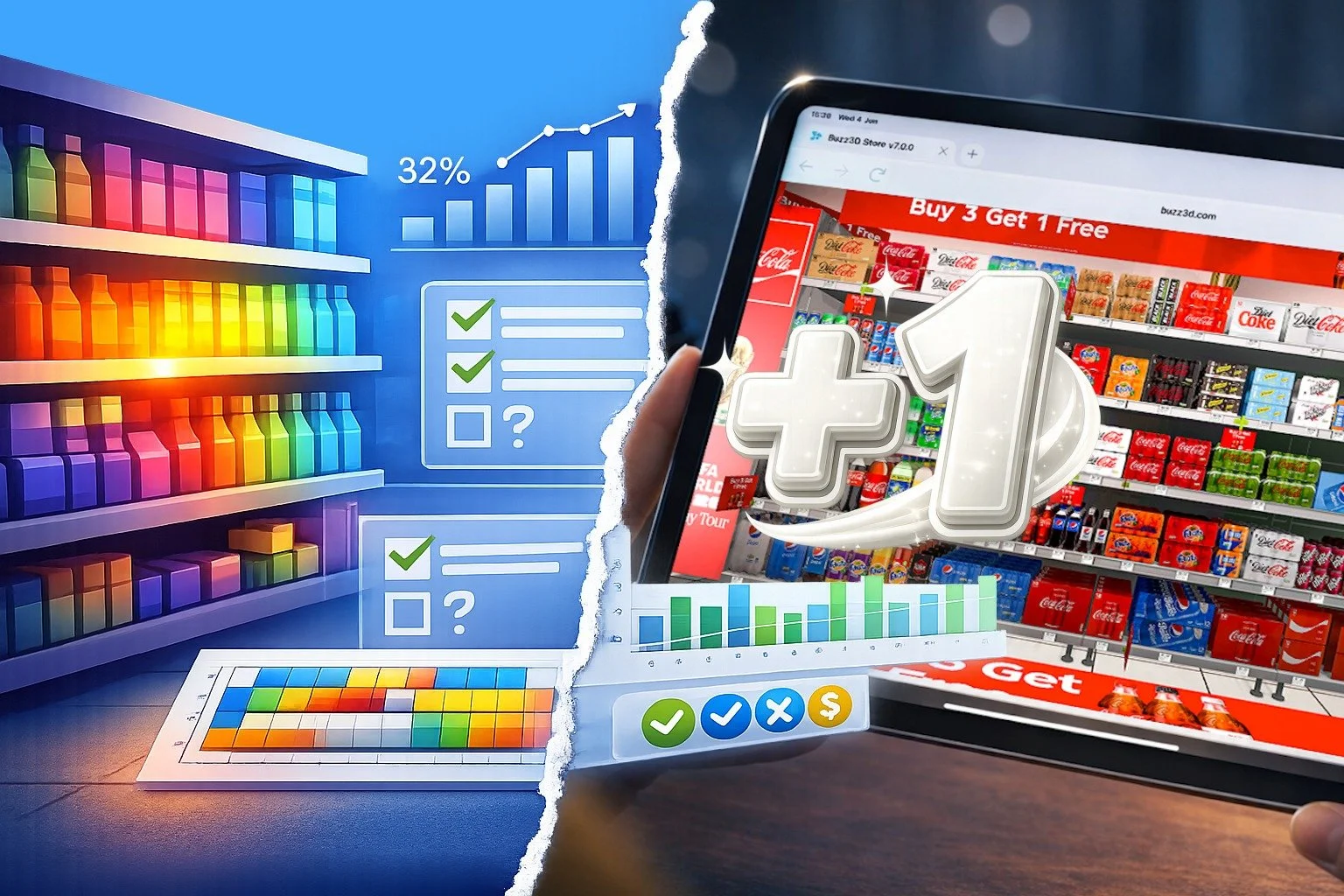
So we’ve added a +1 to the list — not as a replacement, but as something that works alongside the others to help you validate planograms, pricing, and assortment decisions before assigning valuable shelf space.
(Note: pricing frequently changes, so we recommend checking each vendor’s website directly for current details.)
1. Blue Yonder
Unique Features: End-to-end retail planning, demand forecasting integration, supply chain alignment.
Best For: Large retailers needing integrated category, merchandising, and supply chain planning.
Summary: Blue Yonder provides a comprehensive category management platform that connects assortment, pricing, and space planning with demand forecasting and supply chain operations. This enables retailers to align category decisions with real-world constraints and optimise performance at scale. Its strength lies in integrating planning across multiple functions within a single platform.
2. Hivery
Unique Features: AI-driven assortment optimisation, scenario simulation, machine learning recommendations.
Best For: Category teams looking to optimise product ranges using AI-led modelling.
Summary: HIVERY uses advanced machine learning to simulate and optimise assortment and space decisions across categories. Teams can test multiple scenarios and predict performance based on historical data and algorithmic modelling. It is particularly effective for organisations seeking to scale category optimisation using AI.
3. Leafio
Unique Features: Demand forecasting, inventory optimisation, assortment planning integration.
Best For: Retailers seeking to unify inventory, demand, and category planning decisions.
Summary: Leafio combines category management with demand forecasting and inventory optimisation, enabling retailers to align assortment and pricing decisions with stock and demand dynamics. This integrated approach helps reduce inefficiencies and improve availability across categories. It is well suited to retailers looking to modernise planning processes across multiple functions.
4. DotActiv
Unique Features: Planogram creation, space optimisation analytics, performance reporting.
Best For: Retailers focused on visual merchandising and shelf space optimisation.
Summary: DotActiv provides tools for building, analysing, and optimising planograms based on product performance and space efficiency. Its visual approach makes it easy for category teams to design shelves and evaluate how space is allocated across products. It is particularly effective for improving shelf productivity and supporting data-driven merchandising decisions.
5. Quant Retail
Unique Features: Integrated floor planning, planogram design, store layout optimisation.
Best For: Retailers managing both macro store layouts and detailed shelf planning.
Summary: Quant Retail offers a unified platform that connects store layout planning with detailed planogram design and category management. This enables teams to align high-level store formats with individual shelf execution. It is particularly useful for retailers looking to standardise planning across multiple store formats while maintaining consistency at shelf level.
6. Centric Software
Unique Features: Product lifecycle integration, assortment planning, category alignment with product development.
Best For: Brands and retailers managing complex product portfolios and seasonal ranges.
Summary: Centric Software connects category management with product lifecycle processes, enabling teams to align assortment decisions with product development and go-to-market strategies. This provides a structured approach to managing categories across multiple teams and timelines. It is especially valuable for organisations where category planning is closely tied to product creation and launch cycles.
7. Slimstock (Slim4)
Unique Features: Demand-driven assortment optimisation, inventory alignment, forecasting integration.
Best For: Retailers focused on balancing availability, demand, and range efficiency.
Summary: Slimstock’s Slim4 platform supports category management through demand forecasting and assortment optimisation. It enables retailers to refine product ranges based on demand signals, helping improve availability while reducing excess stock. The platform is particularly effective for aligning category decisions with operational efficiency and customer demand.
8. Retail Express
Unique Features: Category performance tracking, merchandising analytics, centralised reporting.
Best For: Retailers seeking improved visibility into category performance and decision-making.
Summary: Retail Express provides tools for analysing and managing category performance across retail operations. Its platform enables teams to track key metrics, assess category outcomes, and refine strategies over time. It is particularly useful for organisations looking to centralise reporting and improve consistency in category decision-making.
9. Analyse²
Unique Features: Shopper insight analytics, category performance analysis, promotional evaluation.
Best For: Brands and retailers seeking deeper insight into category and shopper behaviour.
Summary: Analyse² focuses on delivering insight into category performance and shopper trends through advanced analytics and research data. It enables teams to evaluate how categories perform and identify opportunities for improvement. The platform is particularly valuable for organisations looking to complement planning tools with deeper analytical insight.
10. SAP Ariba Category Management
Unique Features: Supplier category strategy, procurement integration, enterprise spend analysis.
Best For: Large organisations managing category strategies within procurement and sourcing functions.
Summary: SAP Ariba extends category management into procurement, providing tools to manage supplier categories, sourcing strategies, and spend analysis. It enables organisations to structure category decisions within a broader enterprise framework. It is particularly suited to large businesses managing complex supplier ecosystems.
Conclusion
Category management software has evolved to support a wide range of retail planning needs, from enterprise-scale assortment and supply chain alignment to detailed planogram design and performance analysis. Each of the platforms listed here offers distinct strengths, depending on whether your focus is on optimisation, efficiency or visibility.
As always, the right approach starts with defining your objectives — whether that’s improving category performance, increasing operational consistency or raising profitability in limited shelf-space. The good news is that the current landscape provides a strong set of tools to support each of these goals.
But while each of the tools above helps plan and optimise category decisions, none of them directly address how those decisions perform in real shopper interactions before you commit to a rollout.
Now for the +1 add-on to improve them all …
Buzz 3D - De-Risking Your Category Management Process
Buzz 3D occupies a unique position within the category management ecosystem. While many organisations use large enterprise platforms to manage forecasting, planning and operational workflows, the process of moving concepts between planning, testing and validation often introduces friction, cost and delays.
Enterprise platforms are highly capable and play an important role in category management, but many exploratory activities involved in searching for new shelf concepts, assortment strategies, pricing approaches and promotional ideas can become unnecessarily time-consuming during the ideation stage.
Buzz 3D's ability to not only work alongside these solutions, but also operate as a standalone workflow for many category management tasks, helps teams engage with that exploratory process quickly and efficiently. The result is that more ideas can be visualised, tested and refined before organisations commit significant time, resources and budget to full-scale implementation.
Its built-in planogram creation, visualisation and shopper-testing capabilities allow many merchandising, pricing, assortment and promotional concepts to be evaluated before progressing into wider category management and execution workflows - providing a fast and cost-effective way to explore new ideas and gather shopper feedback.
Whether used as a rapid standalone solution or as part of a wider enterprise workflow, Buzz 3D helps teams test more ideas, move faster and make better-informed category decisions.
Want to see Buzz 3D in action? Try our interactive free demo, or contact us to discuss your particular needs.
Summary Table
Here’s how the leading category management platforms compare across key decision-making capabilities.
Legend: ✅ Core capability 🟡 Supports / enhances ✗ Not supported
| Software | Assortment Planning |
Pricing / Promotion Insight |
Space / Planogram Tools |
Forecasting / Scenario Modelling |
Shopper Validation (Pre-Launch) |
Enterprise Scalability |
Core Strengths |
|---|---|---|---|---|---|---|---|
| Blue Yonder | ✅ | 🟡 | ✅ | ✅ | ✗ | ✅ | Enterprise category management, assortment, space planning, supply chain integration |
| HIVERY | ✅ | 🟡 | 🟡 | ✅ | ✗ | ✅ | AI-led assortment optimisation and scenario simulation |
| Leafio | ✅ | ✅ | ✗ | ✅ | ✗ | ✅ | Demand forecasting, inventory alignment, assortment and pricing optimisation |
| DotActiv | ✅ | 🟡 | ✅ | 🟡 | ✗ | 🟡 | Planogram automation, category analytics, space optimisation |
| Quant Retail | ✅ | ✗ | ✅ | ✗ | ✗ | ✅ | Integrated store planning, planograms, and category management |
| Centric Software | ✅ | ✅ | ✗ | ✅ | ✗ | ✅ | Assortment planning aligned with product lifecycle and retail strategy |
| Slimstock (Slim4) | ✅ | 🟡 | 🟡 | ✅ | ✗ | ✅ | Demand-driven assortment planning and inventory optimisation |
| Retail Express | ✅ | 🟡 | ✗ | ✅ | ✗ | ✅ | Category performance tracking, pricing insight, retail analytics |
| Analyse² | 🟡 | ✅ | ✗ | ✗ | ✗ | ✅ | Shopper and category insight, pricing and promotion analysis |
| SAP Ariba Category Management | ✗ | ✗ | ✗ | ✅ | ✗ | ✅ | Procurement-led category strategy and enterprise analytics |
| Buzz 3D (+1) | 🟡 | 🟡 | ✅ | ✗ | ✅ | ✅ | Interactive 3D shelf validation, real shopper testing, behavioural insight before rollout |
FAQs
-
Category management software helps retailers and brands plan, optimise, and manage product categories by analysing assortment, pricing, and shelf space decisions.
These tools are used to improve category performance, align products with demand, and support data-driven decision-making across retail environments.
-
Most category management platforms include features such as assortment planning, pricing and promotion analysis, planogram and space optimisation, and demand forecasting.
More advanced solutions may also offer scenario modelling and AI-driven recommendations to support decision-making.
-
The right solution depends on your objectives. Retailers focused on operational efficiency may prioritise forecasting and inventory alignment, while those focused on merchandising may require strong planogram and space planning tools.
Increasingly, teams are also looking for ways to validate decisions before rollout to reduce risk.
-
Category management software focuses on high-level decision-making, including assortment, pricing, and performance analysis.
Planogram software is more focused on the visual layout of products on shelves.
In practice, many retailers use both together to ensure that strategic decisions are accurately translated into in-store execution.
-
Most category management tools rely on historical data, forecasting, and modelling to predict performance.
While this can provide strong directional guidance, it does not always reflect how shoppers will behave in real-world environments.
-
Retailers can test decisions by simulating real-world shopping experiences and observing how shoppers interact with different planograms, pricing, and assortments.
This approach provides behavioural insight that complements traditional forecasting and helps reduce the risk of underperforming decisions.
-
Shopper validation refers to testing category decisions with real users before implementation.
By observing how shoppers browse, select, and purchase products in realistic environments, teams can gain a clearer understanding of likely outcomes and refine decisions before committing shelf space, thus reducing commercial risk at point of execution.
-
Buzz 3D adds a validation layer to category management by enabling teams to test planograms, pricing, and assortment decisions with real shoppers using interactive planograms in a realistic setting.
This helps category managers understand how decisions perform in practice, improving confidence and reducing risk before rollout.
Buzz 3D has been recognised across multiple platforms for innovation in 3D planogram testing and survey integration.
View our listings on SourceForge, Slashdot, and more.